
Another Animal You Probably Never Heard of: Kirtland's Snake
Secretive, cryptic, disjunct, and rare-maybe that's why

If you’re like most people, myself included, you’ve never seen a Kirtland’s Snake. More likely, this may be the first time you’ve heard of this diminutive reptile. In fact, unless you’re a herpetologist, wildlife biologist, or lucky naturalist spotting one in the wild, you might never encounter this almost mythical serpent at all. To the few who have glimpsed it, Clonophis kirtlandii—more commonly known as Kirtland’s Snake—is a secretive reptile living in the wet meadows hidden in the soft, moist soil of many of the wetlands we saunter through. It is, in every sense, one of nature’s most cryptic creatures.
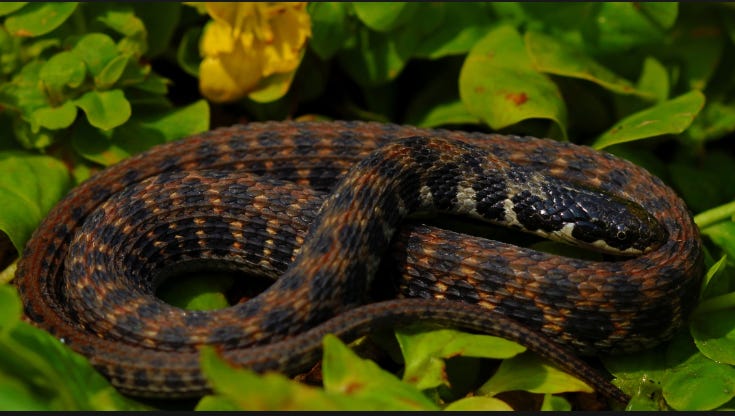
Adults typically measure just over a foot long—14 to 18 inches on average, though some may approach 24½ inches in exceptional cases. Its body sports a subdued gray-brown or reddish hue, overlaid with a pattern of alternating dark blotches that can look faint unless you know exactly what to seek. But the true signature of this species lies beneath: a belly of vivid red, pink, or orange, bordered strikingly by two parallel rows of black spots—a contrast that seems almost too deliberate for survival, as if it were adorned by an artist hiding in the underbrush.
Yet seeing this snake in the wild is akin to glimpsing a ghost. Or winning the lottery.
Once Plentiful, Now Ghosts in the Marsh
Clonophis kirtlandii belongs to the family Colubridae. Although it is in the largest family of snakes (250+species), it is the only species in its genus, an evolutionary loner with no recognized subspecies. Historically, this snake stretched across a swath of the north-central Midwest of the United States—from northeastern and central Illinois through Indiana, Ohio, southern Michigan, western Pennsylvania, and even into pockets of Kentucky and Missouri. Its domain was the mosaic of wet prairies, swamps, and grassy floodplain edges that once stretched unbroken across the region.
Today, however, that landscape exists mostly in fragments. Intensive agricultural development, urban expansion, wetland drainage, and the decades-long degradation of prairie ecosystems have savaged the snake’s preferred habitat. In many parts of its historic range it has vanished entirely, leaving only isolated populations caught in pockets of remnant wetlands or semi-natural landscapes. In Michigan, for example, documented sightings span only a handful of counties—and many of those records date back decades.
This fragmentation has turned what was once a reasonably widespread species into one now considered imperiled on a global level and critically endangered or threatened at the state level across much of its range. In Illinois, it is listed as threatened; in Michigan, endangered; and in several other states it teeters on the brink of local extirpation.
A Life Spent in Shadows
If past abundance now feels like legend, the snake’s behavior reinforces its reputation for secrecy. Kirtland’s Snakes spend much of their lives beneath the surface—often emerging only under conditions that favor concealment. They are frequently found beneath leaf litter, logs, rocks, boards, or, perhaps most tellingly, in crayfish burrows. These subterranean retreats offer moist refuge from the midday sun and concealment from predators, both of which this species seems to prefer.
Unlike their more aquatic relatives, these snakes are rarely seen swimming in open water. Despite inhabiting wetland margins and floodplain forests, they spend most of their time pinned to the fringe of aquatic habitats rather than immersed in them. In the early morning or after rains, when the earth yields and the promise of worm-rich soil beckons, they may surface—briefly and furtively.
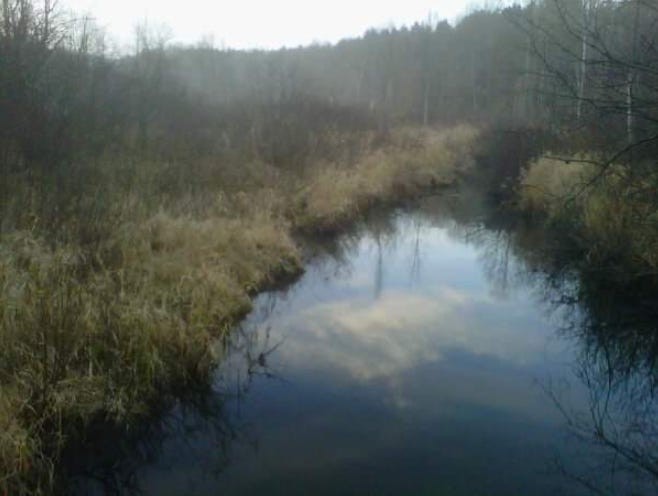
It is precisely this lifestyle that accounts for the snake’s near-mythical status. Scientists describe them as cryptic and nocturnal; citizen naturalists describe encounters that seem almost accidental—a slithering shape under a discarded board, a flash of red belly as one tiptoes into view. Even seasoned field biologists must stake out suitable habitat at the ideal times of year—spring and fall nights, just after rain—to have a reasonable chance of detecting one.
Behavior, Diet, and Life History
Despite its elusiveness, enough is known about these snakes to piece together a life history that is as humble as it is specialized. Kirtland’s Snakes give birth to live young—typically broods of 4 to 15 in late summer—making them viviparous rather than egg-laying like many other reptiles. The juveniles are born darker and with a more pronounced belly coloration, perhaps an adaptation that confers camouflage in the dim light of their subterranean nurseries.
Their diet, too, reflects a snake that lives close to earthworm-rich soil and damp detritus rather than in open fields or dry woodlands. Earthworms and slugs form the bulk of their food, supplemented occasionally by leeches and other small invertebrates. It is a simple menu, yet one perfectly aligned to the snake’s wetland periphery home and secretive foraging patterns.
When threatened, this snake exhibits curious behavior. Rather than striking, biting, or fleeing in the dramatic fashion of more aggressive species, it will often flatten its body and remain motionless, attempting to avoid detection altogether. Only if sufficiently provoked will it employ other defensive behaviors such as erratic movement or musking—a pungent deterrent that might buy a few moments for escape into leaf litter or an animal burrow. I’ve even heard they will coil up and fit on the surface of a quarter, although I haven’t found anything in the literature supporting this claim.
Another claim is that there are no known instances of a Kirtland’s Snake ever biting someone.
Why So Rare? More Than Meets the Eye
To understand why Clonophis kirtlandii is so rarely seen, one must look beyond mere observation frequency and into the ecological and historical forces that have shaped its existence.
First, its habitat specificity makes it vulnerable. The wet prairies and marsh edges it favors were among the first landscapes to be converted for agriculture and development. The drainage of wetlands in the Midwest was so pervasive throughout the 20th century that entire ecosystems were lost, along with many of the species they supported. In that tumult of change, only small, isolated pockets of habitat remained intact—enough for a few populations of Kirtland’s Snake to persist, but insufficient for the species to thrive.
Second, its cryptic lifestyle means that even where the snake still exists, it is difficult to detect through traditional survey methods. Because snakes spend much of their time underground or under cover objects, and because they are small and nocturnal, field surveys can easily overlook individuals. This has led scientists to explore innovative detection methods, such as environmental DNA techniques that can signal a species’ presence through genetic traces shed into the environment—perhaps the future of studying animals that slip through the cracks of human observation. (mdpi.com)
Third, the snake’s biology does not lend itself to captive propagation or human curiosity. Its specialized habitat and diet make it a poor candidate for wildlife trade or captive breeding programs. Many states list it as protected, making collection illegal and rare in private collections. This, unintentionally, has preserved the snake from exploitation, but also limited our knowledge about its potential in managed settings.
A Symbol of What’s Lost and What Remains
It’s easy to romanticize a species that so few have seen, a snake that seems to prefer the company of crayfish burrows and wet meadow shadows over human gaze. But the story of Clonophis kirtlandii is not just one of mystery—it is a tangible reflection of broader environmental change.
When biologists speak of this snake as a relict of the Prairie Peninsula, they mean a creature that once enjoyed much more abundant and connected habitat now shrunk to scattered remnants. The snake itself has been reduced not only in numbers, but in the consciousness of all but a handful of dedicated scientists and devoted naturalists who scour floodplain edges and fen margins for a glimpse of its telltale red belly.
Yet, even in its rarity, the Kirtland’s Snake endures. It persists in forgotten wetlands, and in the crackling leaf litter beneath fallen logs. To see one—truly see one—is to witness a survivor of an ecological era long passed, a quiet reminder of the hidden threads that bind ecosystems together.
And perhaps, in the hush of a marsh at dawn, if you tread softly and watch the earth with patience, you might just catch sight of that subtle pattern flickering through the grass—a living trace of a snake that prefers mystery to fame, shadows to spotlights, and a life unseen to a life observed.
Where do I have a fighting chance to see one?
You’ll need to seek out a remnant fen, wet meadow, or wet prairie in the southwest corner of Michigan. A place like Jeptha Lake Fen, or Ross Preserve come to mind. If you see a log or bark, turn it over; maybe you’ll get lucky.
Geek out here:
https://mnfi.anr.msu.edu/abstracts/zoology/Clonophis_kirtlandii.pdf