
Animal Mis-identifications: Stable Fly vs. Black Fly
Other than being flies, they are completely different animals.

The black fly and the stable fly are two biting flies that often provoke confusion, especially in regions like Michigan, where both occur. Although they share a blood-feeding habit and seasonal nuisance status, they differ markedly in taxonomy, life cycle, ecology, range, and interactions with humans and animals. This article compares the natural history, biology, ecology, and human interactions of black flies (family Simuliidae) and the stable fly, Stomoxys calcitrans.
Taxonomy and Diversity
Black flies belong to the family Simuliidae within the infraorder Culicomorpha. According to Peter H. Adler and Roger W. Crosskey, more than 2,200 species of black flies have been formally named. Did you read that? 2200 species! Michigan hosts approximately 65 species, which still seems too many.
In contrast, the stable fly is a single species: Stomoxys calcitrans, and it is found worldwide, anywhere it is warm enough for it to live & reproduce. While black flies represent a diverse and globally distributed family, the stable fly is taxonomically boring.
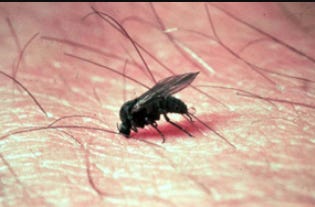
The source of confusion is their multiple common names. Black flies (sometimes written blackfly) are also called buffalo gnat, turkey gnat, or white socks. Meanwhile, Stomoxys calcitrans is known as the “stable fly,” but also as barn fly, biting house fly, dog fly, and power mower fly (my favorite). In Michigan, people consistently and incorrectly call this bug a black fly. I believe this misidentification comes from familiarity with the black fly, which bites. Therefore, any fly that bites is a black fly.
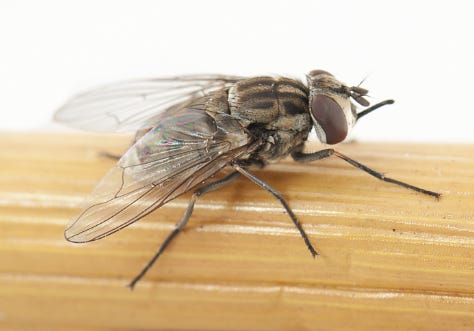
Stable Fly
Physical Characteristics
Adult black flies are described as small, 1–5 mm in length, with short legs and antennae. Their abdomen is broad and black or gray, and the wings are typically clear with a dark margin. They are likened to the size of a pencil lead, with several able to sit on your thumbnail.
The stable fly, by contrast, looks just like a housefly and is the size of a housefly. The size comparison to a housefly distinguishes it from the much smaller black fly.
Thus, black flies are minute, compact flies often barely a few millimeters long, whereas stable flies are larger, housefly-like insects.
Life Cycle and Reproduction
The life histories of the two flies differ significantly, particularly in larval habitat.
Black flies lay their eggs in running water. The larvae attach themselves to rocks in flowing streams and rivers, making them dependent on flowing-water habitats. Breeding success is highly sensitive to water pollution. This ecological dependence ties black flies to clean, fast-moving streams. This explains why they are more common in the northern parts of Michigan and the Upper Peninsula.
After completing larval development, black flies pupate underwater. Adults emerge in a bubble of air and rise to the surface as flying insects. During emergence, they are often preyed upon by trout.
This aquatic larval phase, complete with filter-feeding fans and attachment mechanisms, defines black fly ecology and distinguishes them sharply from stable flies.
Stable flies lay their eggs in manure or rich organic material, like soil detritus. Unlike black flies, stable fly larvae do not develop in water but in decomposing organic matter. This difference in larval habitat—clean, flowing water versus manure and organic detritus—is one of the most fundamental ecological distinctions between the two groups.
Feeding Biology
Both black flies and stable flies feed on blood, but with some differences in behavior and host interaction.
Most black fly females gain nourishment by feeding on the blood of mammals, including humans. However, males feed primarily on nectar. Females require a blood meal before laying eggs. They feed during the day and prefer low-wind conditions. Different species prefer different hosts for blood meals, sometimes reflected in their common names.
Thus, in black flies, blood-feeding is primarily a female reproductive requirement, while males subsist on nectar.
The stable fly also feeds on blood. Females will engorge themselves on the blood of the host, which can only take 3–5 minutes. Stable flies are known to feed on livestock and humans. As the name suggests, the fly frequents livestock and is commonly observed on horses, cows, and even tourists.
Black flies: Tiny, early spring, found along rivers and lakes.
Both flies are vectors for disease. I do not recommend googling what they can spread.
Seasonal Occurrence and Range
Black flies typically emerge several weeks after the snow has mostly melted. Most years, they hatch, do their thing, and are mostly gone by Memorial Day.
The stable fly becomes prevalent at the beginning of summer. Although they mostly stay put in our forests, they can be blown out of the woods onto beaches. If the prevailing wind is from the south, the Lake Superior shore can become covered with them.
They prefer warm, overcast, muggy days, possibly because such days often have a southerly wind component.
Thus, black flies are primarily early-spring insects tied to flowing water in northern regions, while stable flies are late-spring to summer insects associated with forests, farms, and wind-driven dispersal along Great Lakes shores.
Ecology
Black fly ecology centers on flowing freshwater systems. Their larvae filter organic debris, algae, and bacteria from currents, indicating a role in aquatic food webs. Their emergence provides food for fish, which prey upon them during emergence. Their breeding success is highly sensitive to water pollution, linking their population dynamics to water quality.
Stable fly ecology, by contrast, is tied to decomposing organic matter. Eggs are laid in manure and rich detritus, like the surface soil layer in a woodland. Or horse poop.
Human and Animal Interactions
Black flies and stable flies both bite humans, but their interactions differ from there.
Black flies feed during the day and prefer low-wind conditions. Their bites are usually around the neck and head. Because they are mostly gone by Memorial Day in many years, their nuisance period is relatively brief. Long sleeves, gloves, headnets, and DEET provide the best defence.
For humans, stable flies land south of the waist. Tourists on Great Lakes beaches are taken by surprise when exposed bare legs and feet are bitten by a seemingly harmless fly. The best defense? Wear shoes and pants. These flies are not repelled by DEET, and it is uncertain whether they are negatively affected by permethrin.
Both flies are vectors for disease. I do not recommend googling what they can spread.
In summary, black flies are tiny, river-associated insects of early spring; stable flies are larger, housefly-like pests of farms and summer shorelines.⁴ Their similarities—blood-feeding females and nuisance biting—mask profound differences in taxonomy, life history, ecology, and economic impact.
Bibliography
Adler, Peter H. “Medical Entomology of Blackflies.” Annual Review of Entomology 35 (1990): 29–53.
Adler, Peter H., and Roger W. Crosskey. World Blackflies (Diptera: Simuliidae): A Comprehensive Revision of the Taxonomic and Geographical Inventory. New York: Wiley, 2017.
Baldacchino, Frédéric, et al. “Transmission of Pathogens by Stomoxys Flies (Diptera, Muscidae): A Review.” Parasite 20 (2013): 26.
Bishopp, F. C. “The Stable Fly (Stomoxys calcitrans L.) An Important Live Stock Pest.” Journal of Economic Entomology 6, no. 1 (1913): 112–126.
Catangui, M. A., et al. “Calculating Economic Injury Levels for Stable Flies (Diptera: Muscidae) on Feeding Heifers.” Journal of Economic Entomology 90, no. 1 (1997): 6–10.
Cook, D. F., I. R. Dadour, and N. J. Keals. “Stable Fly, House Fly (Diptera: Muscidae), and Other Nuisance Fly Development in Poultry Litter Associated with Horticultural Crop Production.” Journal of Economic Entomology 92, no. 6 (1999): 1352–1357.
Talley, Justin L. Management and Characterization of Stable Fly Larval Habitats at Round Bale Feeding Sites in Pastures. Thesis, Kansas State University, 2008.
Turell, M. J., and G. B. Knudson. “Mechanical Transmission of Bacillus anthracis by Stable Flies (Stomoxys calcitrans).” Infection and Immunity 55, no. 8 (1987): 1859–1861.
How soon before someone tells me this is a black fly?